Showing posts with label salty oat spotlight. Show all posts

8.28.2015

salty oat spotlight: susan fitzgerald of spin spin

This is the third in a series of monthly interviews with inspiring and creative people---including fabric designers, shop owners, quilters, and other makers. You can find all of the previous Salty Oat Spotlight interviews here


This morning, I'm so excited to introduce you to the very talented designer, Susan Fitzgerald. In addition to being the owner of Spin Spin, a design and screenprinting studio which produces textiles, ceramics, and paper goods, Susan is also the latest fabric designer to have her fabrics join the Salty Oat shop! Five Spin Spin designs are now available in an exclusive palette of black, navy, peach, olive green, and metallic gold. These limited-edition fat quarters are printed on an organic, quilting-weight cotton, and are truly special! 


Read on to learn more about Susan's design process, see some beautiful photos of her workspace and materials, and get all of her recommendations of things to see and eat in Melbourne, Australia. And be sure to pop on over to the shop after you've read the interview to snag a fat quarter or two!

Image source: Susan Fitzgerald

Caitlin: Tell us a bit about your background and how you got your start. What was the path that led you to where you are today?

Susan: I started out in web design, doing fun personal projects and working for a long-gone search engine (pre-Google!). After doing that for a year, then a couple of years living overseas, I decided to go back to university and study graphic design. At that time I never thought I'd end up doing design work for a company or even as a freelancer (at least, not full time)---the plan was to use my skills to develop, refine and create my own ideas/designs/products. I wasn't quite sure what form my work would take, but being tied to the computer at design school pushed me in another, much more tactile and hands-on direction. I started by screenprinting covers for books I was making for class, and then fabric to make gifts for friends. And here I am, nearly 10 years later, and I'm totally hooked. I also recently started making hand-formed and painted ceramic pieces, and am hooked on that, too.

Image source: Susan Fitzgerald

C: What does a typical workday look like for you? Can you describe your workspace?

S: I work on my business part-time and there is definitely no such thing as a typical day! I try and squeeze all the many bits and pieces I need to do into the limited time I have and never feel I get half of what I want to do done. I'll usually walk my dog first thing each morning, to clear my head, and then start working on whatever's top of the to-do list---whether it's planning the colour scheme for my upcoming fabric release, making or refining some ceramic pieces I'm working on, printing some fabric or taking photos for Instagram (addicted!) or Facebook. I also spend a bit of time on my website, online shop and working on email mailouts. Computer work does take up a lot of time, but I don't mind that so much these days. Most of my designs start out as a drawing or painting, but being able to scan, manipulate and then get that refined idea onto a screen for printing is pretty amazing. Getting that screen in my hands, ready to print, is always one of the most thrilling moments!
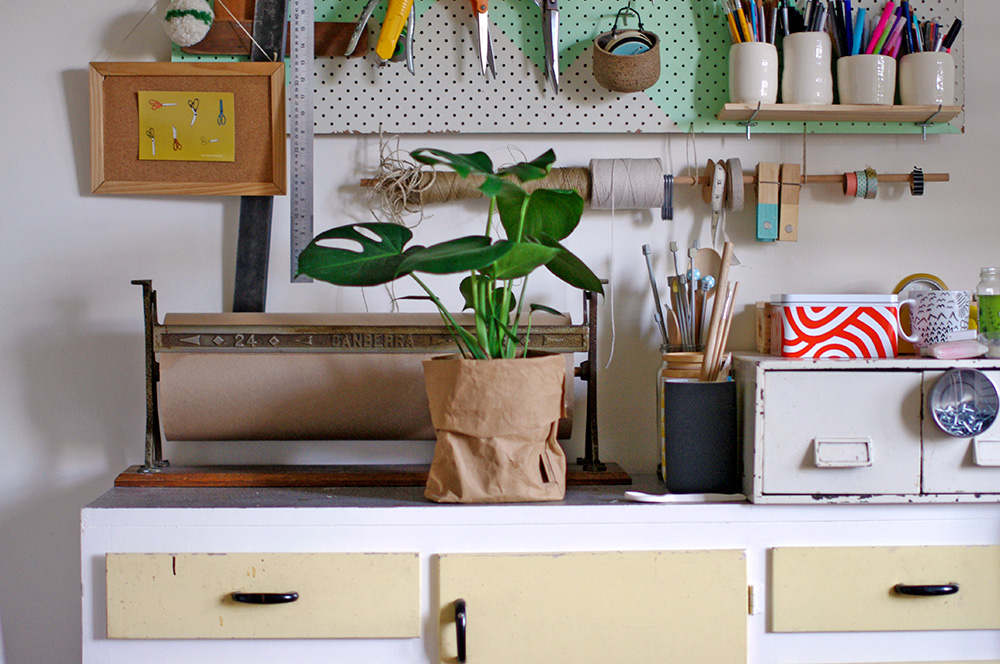

Image source: Susan Fitzgerald

My current workspace is a room in my home, which suits me pretty well as it's so convenient. It's got a big, custom made printing table and a sewing table on one side, inks and screens in the corner, my computer, and then my trusty pegboard on the wall, holding all manner of goodies---clipboards, washi tape, scissors, rulers and so much more. I fluctuate between being super neat and super messy, but generally find that I have a clearer head and get more done when things are neat and organised.

Image source: Susan Fitzgerald

C: What are your sources for inspiration? Can you walk us through how an idea goes from your sketchbook to fabric, and how you refine design elements and select colors and base cloths before committing to printing the final design?

S: I'm inspired by so many things---the nature I see on my neighbourhood walks with the dog, the decaying industrial world near where I live in Melbourne's inner west (lots of old factories, warehouses, shipping containers, etc.). Travel is the best for inspiration---I find I notice every tiny thing and want to capture little fragments. In terms of aesthetics, I love simple, minimal designs with limited colour palettes and natural materials, so am drawn to Japanese and Scandinavian design. I also love imperfect things---singers who don't always sing perfectly on key (hello, Will Oldham, Bill Callahan, Jason Molina), ceramic pieces that are a little wonky, screenprints that don't quite register 100% correctly.

Image source: Susan Fitzgerald
 
Over the years I've tried to develop working methods that feed, rather than stifle, my creativity. So if I just feel like sitting at the kitchen table, in the sun, drawing or painting (or making some ceramic pieces), and I've got time for it, I'll do that. That way I end up with lots of doodles and patterns on file. I'll look through them now and then and if something stands out, or if one of them's stuck in my mind for a while, I'll work with it and develop it. That can take an hour or a couple of months of tweaking, forgetting, going back to, etc. Sometimes it can be hard to get an idea translated into a design, and there are a couple of them that are stuck in my brain and have been for a few years. I figure they'll find a form some day...

If the design is hand-drawn, or stamped, I often like to translate that look from the page to the computer screen and then fabric. I'm not really into the clean vector/Illustrator look at all---my work is the antithesis of that, really. I'll usually scan artwork, use Photoshop to crank up the black/white contrast and then use Illustrator to work with colours, ideas, to repeat the pattern, etc. Each design is different, but usually I'll arrange the pattern so it looks the way I want it to, then print some of it out on an A4 page, at 100%, to make sure the scale is correct. I'll also print the whole thing onto an A4 page to make sure the overall look and feel is right. Then it's a matter of sitting on it for a while, looking at the print-outs upside down and sideways, tweaking the design and then settling on something that 'works.' 

 Image source: Susan Fitzgerald

Every few months a colour will stick in my head and when I get time, I'll pull out the Pantone swatch book, try to match what's in my head to the book and then get the ink formula from there. Getting the ink colour right is far from an exact science---you've often got to tweak it a lot to get it right, but it's a fun process generally, especially when you do the first print run and it comes out just how you imagined it. I love natural fabrics---hemp, linen, cotton---and use organic where possible. I tend to use light-coloured basecloths, but would love to find a pale grey linen---the holy grail! Fabric selection is often limited to what's available in organic, and also by cost---I try to keep my fabric affordable.

Image source: Susan Fitzgerald

C: What three words would you use to describe your aesthetic?

S: Imperfect, minimalist, natural.

C: What projects have you or your customers made with your fabrics?

S: I've made a few quilts and really want to start on another---I need the mojo to get started, as it takes a while to complete a quilt. I also have a footstool which was upholstered with some of my custom-printed heavy weight hemp fabric. I also produce a range of cushions, zip purses, baby dribble bibs, onesies and more. I really want to make a lampshade or two soon---that's the next thing, hopefully.

Image source: Susan Fitzgerald

Little Noggi from Melbourne recently made a hat range using a custom print run of my fabrics. Bonbies in Hong Kong uses my fabric to make adorable children's shoes. And you can see lots more with the hashtag #hellospinspin on Instagram. You've also inspired me to make a page on my website with customer creations. :)

C: Tell us a bit more about Melbourne. Where are you favorite places to shop, eat, or spend time with your friends and family?

S: Melbourne is renowned as a place where people wear a lot of black and drink a lot of coffee. It's the home to many of musicians and artists and has a long history of supporting independent creatives. Melbourne is in the southern part of Australia---that means it gets hot in summer, but in winter it gets cold, and people hunker down and make things. There are lots of big and small galleries, all sorts of creatives tucked away in studios all over the place. Food is something Melbournians are REALLY into and there are so many great cafes around, as well as pubs/restaurants/bakeries/coffee houses/craft brewers, etc. 

Around where I live I love Guerilla Espresso, Brother Nancy, Post Industrial Design, The Little Man and Rudimentary for breakfast/lunch and for later in the day, Plough Hotel, Ovest, Ajitoya, Station Hotel, 8bit and Littlefoot are all amazing for food and/or drinks. The best places for coffee, in my opinion, are Market Lane and Patricia, and they're worth [the drive] to the city for. For homewares, you can't go past Sedonia and for art goods, West Art Supplies.

Image source: Susan Fitzgerald

C: Where can people find you online? 

S: My website is spinspin.com. You can buy my wares via Etsy. I'm also on Instagram, Facebook, and sometimes Twitter.

Thank you so much to Susan for taking the time to answer my questions! It's always so fun to learn more about the designers whose work I carry in the shop, and to get a peek into their part of the world. 

7.15.2015

salty oat spotlight: julianne walther


This is the second in a series of monthly interviews with inspiring and creative people---including fabric designers, shop owners, quilters, and other makers. You can find all of the previous Salty Oat Spotlight interviews here

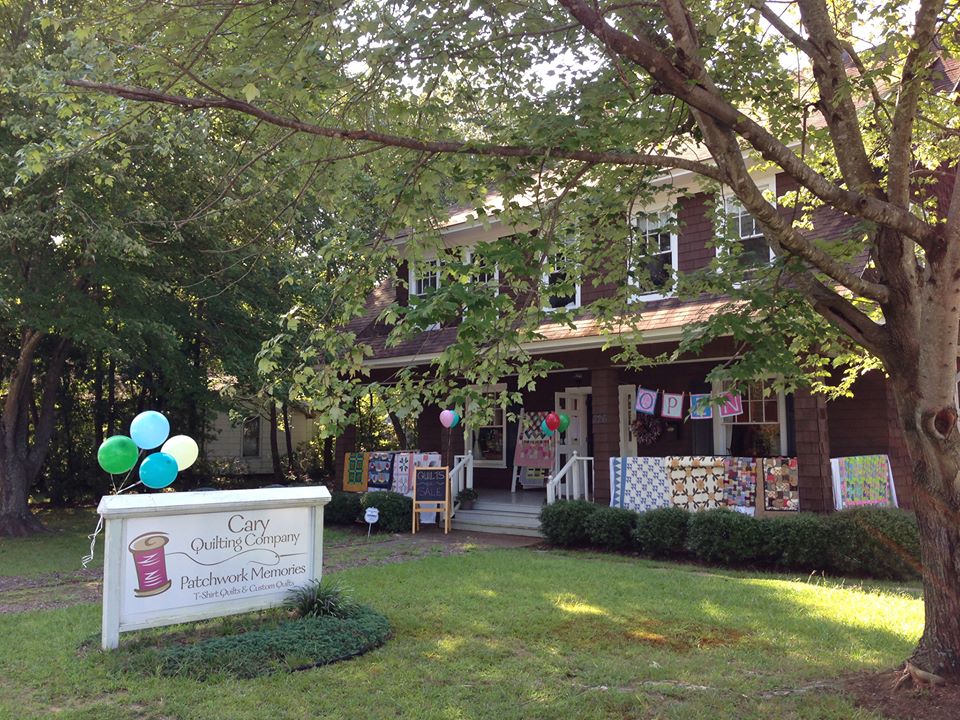
Today, I'm so excited to introduce you to Julianne Walther, the owner of a fabric shop and t-shirt quilt company based in Cary, NC. I first met Julianne last summer, while living in North Carolina, and I had the opportunity to piece a handful of t-shirt quilt tops for her company. Read on to learn a bit more about how she got her start, the crazy number of things she accomplishes in one day, and her personal connection to American-made fabrics.

 Image source: Julianne Walther

Caitlin: Tell us a bit about your background and how you got your start. What was the path that led you to where you are today?

Julianne: I have always sewed. I remember sitting at the foot of my mother's machine, playing with her pins and tomato pincushion. She taught me how to sew clothing for my dolls and little things for my dollhouses. I made clothing for myself in high school and in college. Shortly after college, I grabbed a DIY quilt book and followed the directions. I was hooked!

Fast forward about 10 years...I'm married with four little ones between 1-5 years old. I'm not the type that sits around well, so I decided that I needed a little something extra to do with my time while the kids were napping or after their bedtimes (ha ha!). My husband built a small webpage advertising my new little side business of making t-shirt quilts. I immediately started getting orders, and Patchwork Memories was born.

The business grew and grew. Seven years in, Patchwork Memories had a staff of nine people working to create the quilts and memory bears that we offered. Some worked from their own homes, and some worked in my home with me and our pets. We simply needed more space! My favorite local quilt shop, located on the main street in our little downtown district, had closed when the owner retired. The building had been vacant for a couple of years. It seemed like a great place to move Patchwork Memories. We took a tour (though I already knew the building well!) and made the big decision to move to a retail space.

As soon as we started to move things in, eager quilters began knocking on our door, wanting to know when we were going to open "the quilt shop." Everyone seemed to want a quilt shop back in the historic home. Who was I to deny quilters fabric? We quickly made a plan and opened a quilt shop on the first floor of the house. In January of 2013, Cary Quilting Company opened its doors to the quilting community. Two and a half years later, we are scrambling for space for all of the pretty fabric that comes in. I now own two thriving businesses and those four babies are now teens and preteens! Life is never dull for me! 

Image source: Julianne Walther

C: What does a typical work day look like for you?

J: There is not really a "typical" day for me! Yesterday, I shipped two Patchwork Memories quilts, one to New Jersey and one to Minnesota. I longarm quilted two more Patchwork Memories quilts. I designed a custom t-shirt quilt, I took in five longarm quilting orders, I did some embroidery for clients, placed a few orders for the shop, and generally ran around answering questions. Today, I wrote a shop newsletter before 8 am! I've been cutting fabric kits for the shop, placing re-orders, helping our Inventory Manager check in 30 bolts of brand-new, pretty fabric, and the list goes on and on! One thing is for sure: it always revolves around fabric and quilting!

Image source: Cary Quilting Company

C: Tell us a bit more about your store, Cary Quilting Company. What does the shop itself look like?

J: The shop resides in an historic home built in 1930. The house has tons of character, but tends to be a bit drafty. Local quilters love it, because the house is synonymous with quilting, having been home to quilting shops for about 40 years.

I love many different types of fabric, so you'll find batik, modern, reproduction, solid, novelty, blender, and Daiwabo fabrics, and plenty of sale fabrics as well. We also have every surface covered with patterns, precuts, books, gifts, and other must-haves. It's a fun explosion of color and inspiration---I always tell people that it's a much prettier environment than being at home!


Image sources: Cary Quilting Company and Julianne Walther

C: How do you decide which fabrics and notions to carry on your shelves? I see that you sell American Made Brand solids. Why is it important to you to carry domestically produced products?

J: Choosing fabrics is one of the hardest parts of my job! I know what I love, but I have to guess at what my customers will love too. I often get input from other staff members and even customers sometimes when it's hard to make a decision. The other hard part is stopping! When we were first getting started with the shop, we ordered a ton to fill the shelves. Now that we have nowhere else to put anything, I have to be a bit more selective when I order. It's not uncommon for fabric sales reps to roll in several suitcases full of samples, so it's hard to say no sometimes!

American Made Brand fabrics were a no-brainer for me. My mother grew up on a North Carolina farm, and my father grew up in a South Carolina mill town. American-made fabric provides jobs to people in our communities. Some of the cotton grown for that line of fabric comes from Carolina farms---that means so much to me! I was moved to enter the American Made Brands Farm to Fabric challenge last year, and my quilt was chosen to travel as a part of the exhibit (still traveling)! I'm looking forward to entering this year's challenge too.

C: Do you have any general advice for other creative entrepreneurs about starting and running a fabric-based business? What's been most successful for you? Least? Any recommended resources?
 
J: Expect to work more often and much harder than you're planning or hoping, because the jobs are never done (Believe it or not, I'm typing the answer to this question in a doctor's office waiting room right now! Seriously, the job never ends!). It's so important to love what you do---without the passion, it's not much better than any other job, I would imagine.

I believe in treating people well, and that goes for my coworkers and our customers. I surround myself with positive people who share my enthusiasm for fabric and quilting. Community is a big part of our shop. Our clubs (Quilt a Murder, Mystery Quilt, Block of the Month) and classes are a big part of fostering our quilting community, with which our businesses can thrive.

In terms of resources, I rely on the opinions and experiences of quilters around me. I never took a business class or ran a business before suddenly owning my own, so I'm not much help there! I think that treating people well and sharing kindness goes a long way. People know when you care about what you do, and if you're sincere and genuine, people see that too.

 Image source: Cary Quilting Company

C: What’s Cary, where your shop is located, like? Any favorite places to shop, eat, or spend time with your family?

J: Cary is a great place to live and work! It's been rated the third safest city in America. It's the 19th best place to live in America according to Money.com. It's the third best place to start a small business. It's one of the most educated cities in America. The schools are great, the town is beautiful and clean, full of arts, cultural resources, greenways, and entertainment.

Our family actually had the option to move anywhere in the US with my husband's job several years ago, and we just couldn't find a reason to leave Cary. It's an amazing place to raise a family. Our shop is located in the heart of downtown Cary, on the main street, Chatham Street. The shop is within walking distance of the Arts Center, the library, the Cary Theater, many restaurants, the train station, and much more. You'll have to come visit!

C: Where can people find you online? Do you have any upcoming events or classes you'd like to share?  

J: We have an exciting set of fabric dying classes coming up in July! Kelly Hutchens will be visiting from Kentucky to share her techniques with us.  You can find our classes online here. And most of our shop is available online here. We also have Facebook, Pinterest, Instagram, and Twitter pages.

Thank you so much to Julianne for her thoughtful answers. I hope you'll stop by her shop if you're ever in North Carolina!

6.01.2015

salty oat spotlight: sarah waterhouse

Today is the first in what I hope will be an on-going series of interviews with inspiring and creative people---including fabric designers, shop owners, quilters, and other makers. To kick things off, I'm so excited to welcome Sarah Waterhouse to the blog! Sarah is an incredibly talented fabric designer based in England, whose work I have the pleasure of stocking in the shop. Sarah's designs are fresh, modern, and often geometric, which is what immediately drew me to her work when I stumbled across it almost two years ago. Read on to learn a bit more about her background, her design process, and how she has environmentally friendly fabric specially woven for her.

Image source: Sarah Waterhouse

Caitlin: Tell us a bit about your background and how you got your start. What was the path that led you to where you are today?

Sarah: I studied art and design at college but decided to pursue the academic side of the subject by doing a History of Art & Design degree at Sheffield Hallam University in 2000-2003. I loved Lino printing at college, but never got a chance to screen print and I was determined that I wanted to have a go. So when I finished university I went to work in an art gallery and started to teach myself how to expose screens and screen print and soon became addicted. I also had to teach myself how to put designs into repeat and absolutely loved working with patterns. I used my new fabrics to make gifts for myself, family and friends and it just blossomed from there.

C: What does a typical work day look like for you?

S: I get into work early, usually around 7am, and deal with all my admin, marketing and orders first so I can spend the rest of the day on the practical side of the business, so designing, sewing and printing. There are also extremes in my working week so some days I might be completely glued to the computer and others I’m printing all day. I love the variety in my work!

Image source: Sarah Waterhouse

C: It’s not always easy---from a sourcing or financial standpoint---to use organic fabrics, but sustainability and environmentally friendly materials are obviously a big part of your company’s story. Why is that?

S: I’ve always been very environmentally minded and determined that once I started a business, it would continue in the same thread. I didn’t like the thought of putting something else out into the world that was damaging, and the processes surrounding cotton production are so polluting. It was very difficult to source both materials and inks though. Even looking for the right packaging was difficult as I didn’t want the quality to suffer in the face of the environmental aspects. Once I found some good suppliers for fabrics and started buying in bulk, my choices grew. I’m now at the point when I’m able to commission my own woven cloth made here in the UK and that is wonderful.

C: What three words would you use to describe your aesthetic?


S: Bold, contemporary and colourful.

Image source: Sarah Waterhouse

 C: What’s your current favorite color palette?

S: I love all the colours as you can probably tell from my fabrics, so I don’t really have a favourite palette. I don’t like to limit myself in any way. I love putting different colours together and creating unusual combinations.

C: What are your sources for inspiration? Can you walk us through how an idea goes from your sketchbook to fabric, and how you refine design elements and select colors before committing to printing the final design on fabric?

S: Most of my inspiration comes from nature so either from direct sketches or photographs I’ve taken. I carry a sketchbook and my camera with me everywhere so I can record any interesting shape, pattern or composition I find. I sketch all throughout the year but twice a year I have a period of about 2 months when I concentrate on work specifically for a new collection. I look through all the work I’ve done so far and then start picking out elements I find interesting to build up a set of about 10 different ideas which are worked on again to see how they could be turned into repeat patterns and my final choice cuts this again down to 3 designs. Once I’m happy with the designs, I refine them as a repeat pattern and get the screen etched. Whilst I wait for the final screen to arrive, I start work on mixing colours. By this point I usually have colours in mind which have come from the point of inspiration. I usually mix up about twice the number of colours I think I might need and do test swatches until I’m sure of the final set and am happy that they all work well together.

Image source: Sarah Waterhouse

C: What projects have you or your customers made with your fabrics?

S: My customers use my fabrics for a variety of uses which is lovely, that’s why I like being able to offer many different weights of fabrics that are suitable for a range of uses. My designs have been used on everything from upholstery to clothes. I always ask my customers to share any images with me of the finished work. It’s lovely to see my fabric become a part of someone’s home or wardrobe.

C: What’s Sheffield, where your studio is, like? Any favorite places to shop, eat, or hang out?

S: Sheffield is a wonderful place to live. I was born here and couldn’t really see myself making my home anywhere else. We’re the greenest city in the UK with more trees than people and we’re surrounded by one of the country's most beautiful national parks, the Peak District, so I’m very lucky to live here. We also have a fantastic cultural vibe in the city, especially music, art and design. There are so many makers based here and we have lots of studio spaces. My studio is lovely. It’s my home away from home and I share it with my husband and our rescue pug Etty. The room is mostly taken up with a huge printing table, 8.5m in length.

Image source: Sarah Waterhouse

C: Where can people find you online? Do you have any upcoming in-person events or open studios?

S: I sell through my own website shop. I also sell through Etsy and have a number of stockists. I like to do as many trade and retail shows in the year as I have time for and try to visit as many places in the UK as I can. The big event of the year is definitely our Open Studios though, which happens every November. This year it’s the 20th-22nd November and all of our studio buildings are open over the weekend so that’s the chance to see about 140 different artists and makers. I like to put on a good display and sell a variety of different fabrics and finished items over the weekend and it’s a lovely chance to meet so many of my customers face to face.

Thank you so much for your thoughtful responses, Sarah! You can find a selection of Sarah's fabric in the Salty Oat shop (it's currently on sale!), along with a recently added pair of pillows featuring her designs (red and orange), which I made in my studio.